by Jordan Fridley
Wordless novels, also known as woodcut novels, use sequences of wordless images to tell a story using woodcut and other relief printing techniques. The genre reached its peak popularity in Germany in the 1920s and 1930s, prior to the rise in film and anti-socialist censorship, particularly in Nazi Germany and the United States. The content typically centers around socialist themes, critiques of capitalism, or frustration at sociopolitical injustice. Use of strong imagery in this way transcends potential language barriers, making the message accessible to all regardless of language.
Frans Masereel (1889-1927), a Belgian woodcut artist, is considered the “father of wordless novels.” He spent most of his childhood in the city of Ghent, where he was trained as a book printer, typographer, and lithographer, and participated in socialist intellectual circles in France. Masereel expressed his beliefs in many of his works, influenced by the political and social upheaval of 20th century Europe.
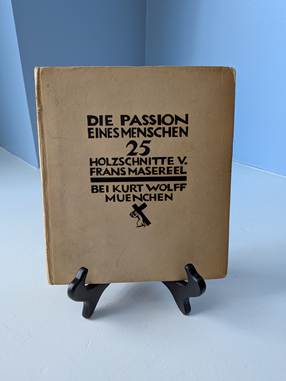
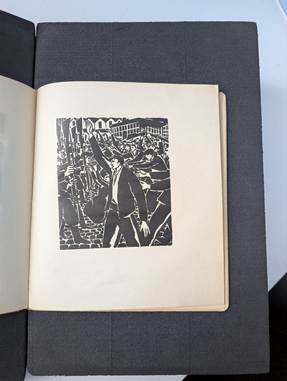
Cover and a page from Frans Masereel’s 25 Images de la Passion d’un Homme (25 Images of a Man’s Passion.)
Several of Masereel’s works are housed in rare books, including 25 Images de la Passion d’un Homme, or 25 Images of a Man’s Passion, which follows a young, working-class man in his organization of a revolt against his employer. Also included is Danse Macabre, which serves as a homage to the artistic allegory popularized in the Middle Ages depicting the fragility of life and inevitability of death.
Lynd Ward (1905-1985), an American graphic illustrator and novelist, popularized the wordless novel in United States and influenced the development of the graphic novel genre. He studied fine arts at the Teachers College of Columbia University and later continued his studies at the State Academy of Graphic Arts in Leipzig under Hans Alexander Müeller, a prominent German American woodcut artist. There, he became acquainted with the works of Frans Masereel, and published his first wordless novel, Gods’ Man (1929.) He went on to publish five other wordless novels and illustrate over one hundred children’s books.
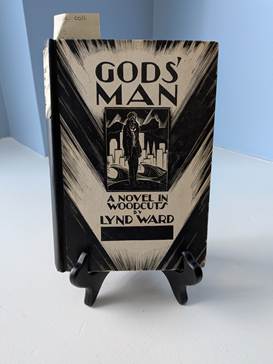
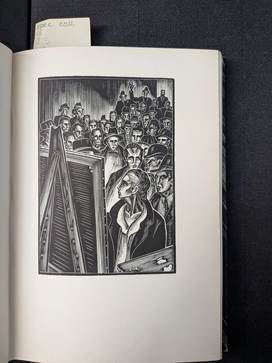
Cover and a Page from Lynd Ward’s God’s Man: A Novel in Woodcuts.
SCUA has a large variety of Lynd Ward’s works, including Gods’ Man, which follows an artist who trades his soul for a magic paintbrush. Also notable is Wild Pilgrimage: A Novel in Woodcuts, which “tells the story of a man who, finding himself born into a drab industrial world, is conscious of a great difference between his immediate surroundings and the world his mind creates. In undertaking to bring these two worlds together he first tries the easy road of escape, only to confront finally the fundamental problem of our time—the question of individual as against mass salvation (Dust Jacket.)”
Wordless novels, including the works of Masereel and Ward, illustrate how visual art can serve as historical witness and commentary. Born of sociopolitical upheaval, the genre served as a bridge between literature, activism, and art, making calls for justice and equality heard over cultures and languages.