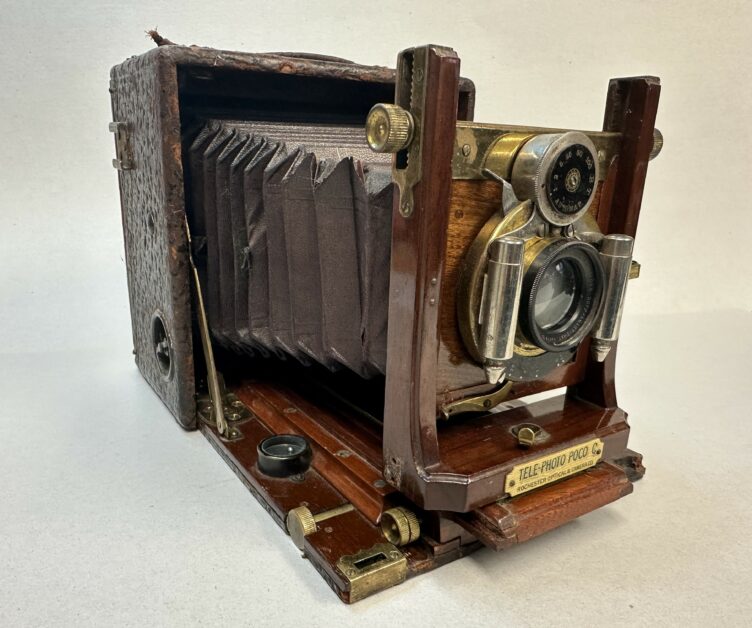
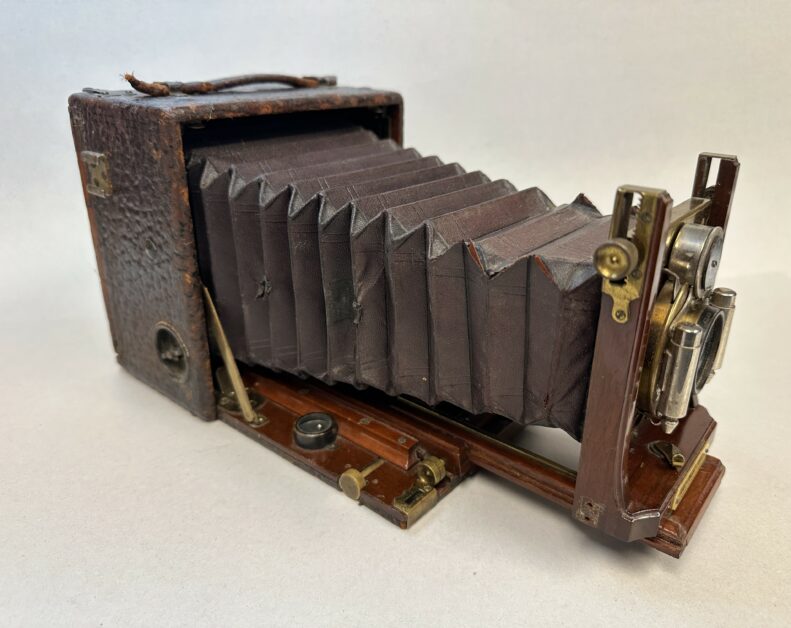
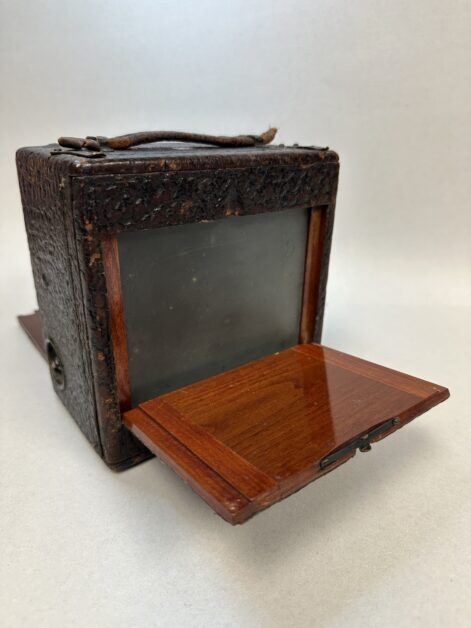
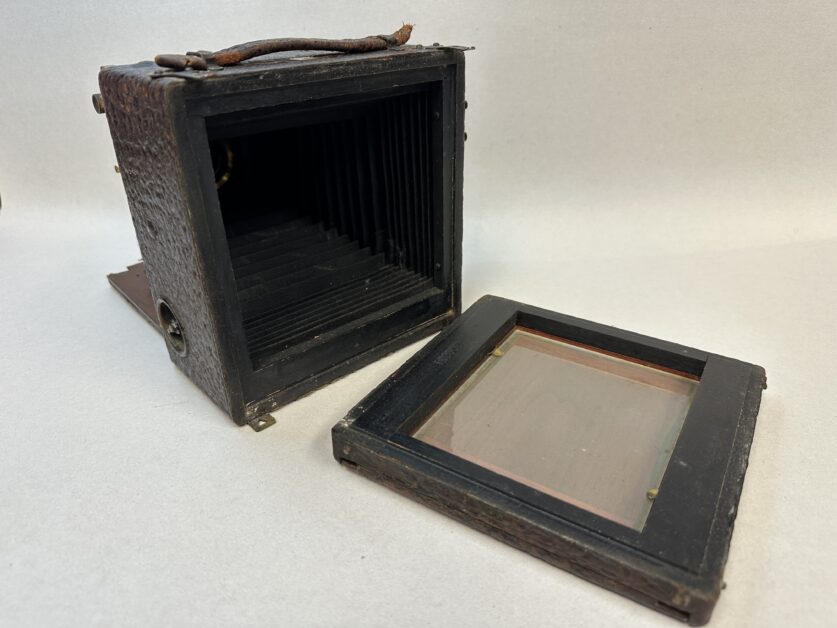
Special Collections was delighted to receive a beautiful historic Tele-Photo Poco C camera, which was manufactured by the Rochester Camera and Supply Company in Rochester, New York. The self-casing, red bellows-folding camera has a striking mahogany wood case covered in “elephant grain” black leather, a design primarily seen in American designs. It had multiple lenses and came in three sizes. Although very popular, the model was produced only between 1887 and 1889. In 1903, the company was purchased by George Eastman and renamed the Rochester Optical Company.
“When you think of photography, you may think of it as a relatively modern invention. On the contrary, photography began with the camera obscura as early as the 10th century AD, and some evidence seems to indicate that Aristotle was familiar with this technique as early as the 4th century B.C. The camera obscura was a darkened room with a tiny hole in one wall, with a white screen on the opposite wall. In the mid-16th century, lenses were added to the camera obscura’s aperture to produce a brighter, sharper image. Over time, the camera obscura became more compact, and the image was projected onto thin paper on glass so it could be traced. This was used as a sketching aid by artists.
Sketching the images on the camera obscura took extra time, but in 1725, Johann Heinrich Schultz learned that exposing certain silver salts to light could capture the image without tracing. Over the next 75 years, scientists investigated these properties of the silver salts, but none could practically use the discovery to produce permanent images.
In the early 1800s, the camera obscura had become a portable, light-tight box containing materials and chemicals that would temporarily record the image through the lens. Cameras created in the 1800s were often crafted for both aesthetics and functionality. For instance, fine woods were used with brass fixtures to showcase the equipment. Wood had the advantage over metal because it was lighter, allowing the camera to be made larger, which would give the photographer more movement and extension. The wood was also exceptional for dampening vibration, which could affect a metal camera and blur the picture. On the other hand, the metal cameras had the advantage of less flexibility for long extensions. The metal cameras could be knocked over with minor damage, while the wooden cameras could be shattered if they hit the floor. In 1900, Eastman Kodak introduced a small camera called the Brownie, an inexpensive box camera that popularized snapshots. The original model was made of cardboard and contained a simple meniscus lens that projected a 2 ¼-inch-square image onto 117 roll film. It cost only $1.00 and had straightforward controls. The line of Brownie’s cameras was very popular and was sold for over 70 years.
The Rochester Optical Company was founded by William H. Walker and later merged with the four other companies to form the Rochester Optical and Camera Company. Initially, the company made dry plates and built cameras. When the five companies joined forces, they continued to make cameras even after they were bought by the Eastman Kodak Company.
Other companies, such as the Rochester Optical Company in New York, continued to produce more expensive models with varying features. The Rochester Optical Company produced the beautifully wood-finished Commodore model from 1891 to 1902, featuring maroon cloth bellows and a solid wood bed. Less expensive models were offered that did not feature a swinging mechanism.
Field-viewer cameras underwent an astonishing evolutionary process throughout the 1800s. This may be partially because there were so many new inventions being created, then taken and used by new companies. Camera manufacturers were constantly competing against other companies that had inside knowledge of their own business, products, and inventions because of job-hopping employees. Cameras evolved from wooden boxes with a tiny hole to models that are very similar to view cameras used today. By the beginning of the 20th century, they were made of wood and featured rear and front standard monorail or sliding rails that were fixed to the flatbed, which attached to the camera support. When the bellows were folded, the flatbed could be folded to reduce the camera to a light, small, portable box. The experiments of the preceding century brought about exciting new changes as they led to handheld cameras. Before 1888, glass plate cameras were very large and limited to the perspectives that could be captured from a tripod. Because they could pick up cameras and shoot pictures in the early 20th century, practitioners in other disciplines and amateurs could experiment with photographic perspective to explore their own ideas and creativity. Modern photographers still work with perspective to give pictures a dynamic, unique appearance and attitude.” – History of Field View Cameras www.fiberq/cam/
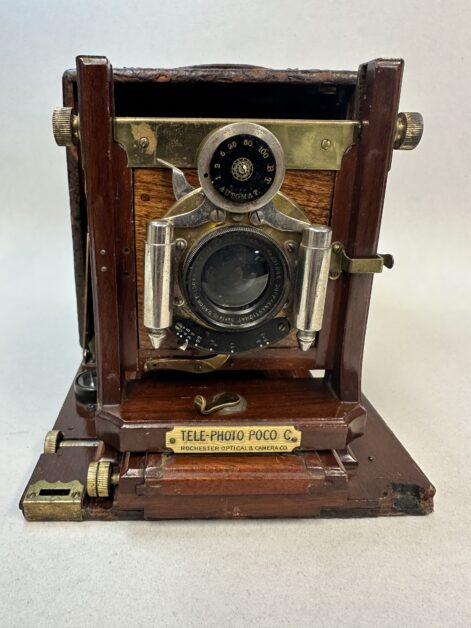
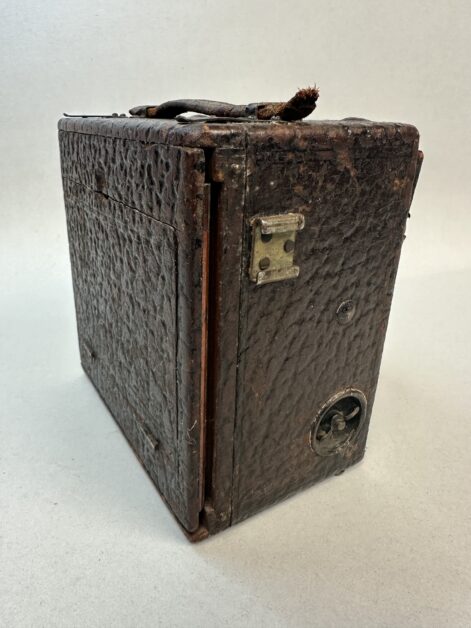
This lovely historic artifact, in such excellent condition, has now been cleaned by senior conservator Audrey Sage. A felt-lined conservation box has been constructed to house this camera, protecting it and keeping it safe among its companions housed in our amazing photography and historic camera collection.
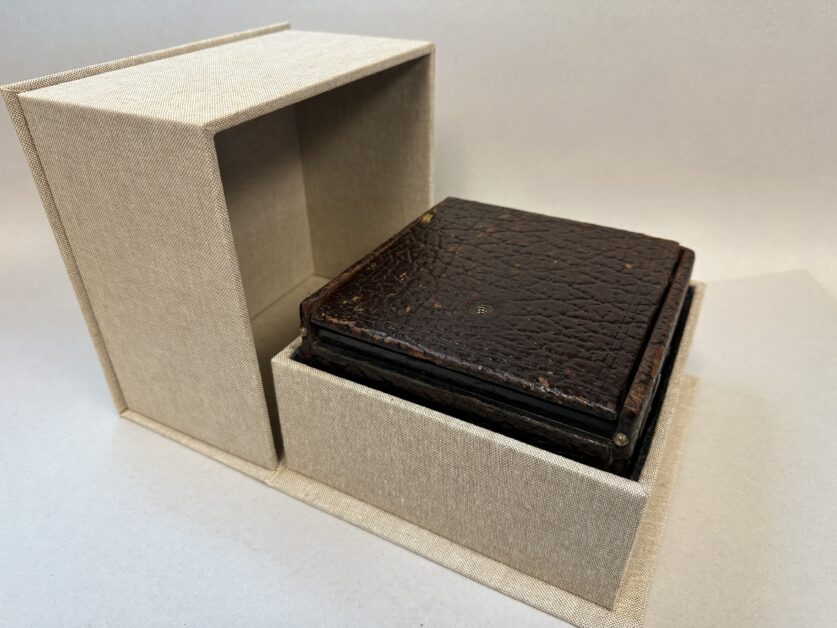
This fine historical object is a great addition to the Special Collections Camera and Photographic Ephemera Collection, https://uncg.as.atlas-sys.com/repositories/2/archival_objects/125451 .