The “NINA M.H.” SCRAPBOOK MYSTERY
BY HERMANN TROJANOWSKI
My name is Hermann Trojanowski, and I am the former Special Projects Archivist at UNCG’s Special Collections and University Archives Department (SCUA). One of the projects on which I worked while at SCUA was conducting oral history interviews for the Betty H. Carter Women Veterans Historical Project (WVHP). After I retired, I began volunteering with SCUA and for the last couple of years, I have been volunteering with WVHP creating metadata for the over 120 scrapbooks in WVHP’s collection. There are some very interesting scrapbooks in the collection and the “Nina M. H.” scrapbook was unique in that it created during World War I by a woman whose identity was mysterious and who was with the little-known National Service School for Girls in Washington, DC.
I love solving a mystery, especially one involving genealogy. Recently, WVHP purchased a scrapbook, and the only identification that we had for the creator of the scrapbook was a woman named “Nina,” or “Nina M.H.” who served with of the National Service School during World War I.
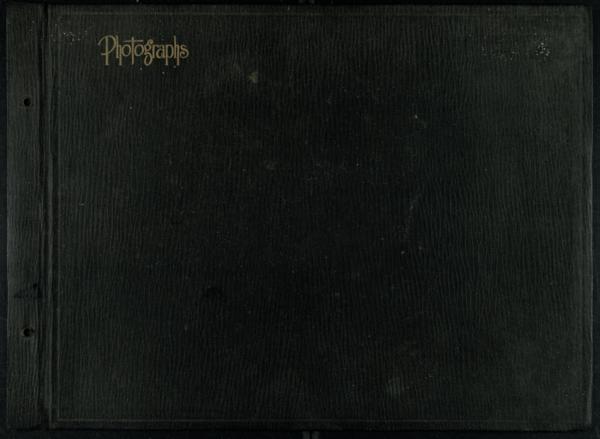
The eighty-page scrapbook’s cover consists of textured black paper over heavy board with the word “Photographs” gold stamped in the upper left corner. The interior materials are photographs affixed to the heavy black sheets. There are handwritten captions related to the photographs as well as notes about “Nina,” her comrades, and places they visited.
In researching the National Service School, I found out that in 1916, the wives of the chiefs of the United States Army, Navy, and Marine Corps, as well as the Navy League, established it as paramilitary program designed to prepare young women to support the United States Military during “war or national calamity.” The school was located in Chevy Chase, Maryland, and was specifically tailored for war work such as making and applying bandages, home care of the sick and wounded, and nursing, as well as serving as ambulance drivers, aviators, chauffeurs, and other capacities usually filled by men. The students lived in tents and wore a uniform style dress that was recommended but was not mandatory. The young women were grouped into companies of fifty each under the command of a captain and two lieutenants selected from their numbers. The training program closed in 1919 after the conclusion of World War I.
I was determined to leave no stone unturned to identify the full name of “Nina,” so I could write a biographical sketch for her scrapbook. There were several photographs included with the handwritten words, “Nina” or “Nina. M.H.” and an arrow pointing to a person in the photograph, but no last name.
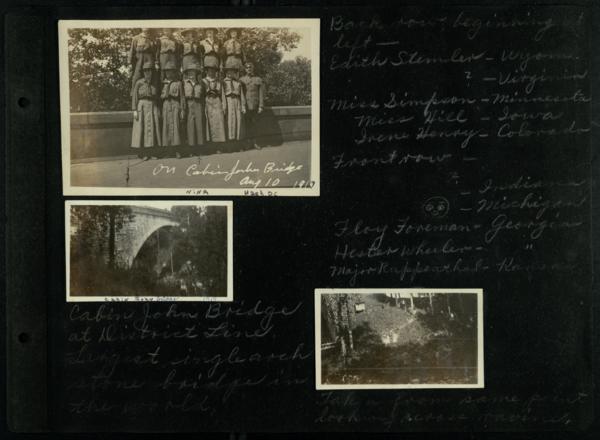
One photograph showed four women in full military-type uniforms and had the name “Nina” handwritten in the border and below the photograph was a list identifying the women. One of them was identified as “Sargent Hodskin.” Bingo, I finally had a last name for “Nina”!

After discovering her last name, I used both Ancestry.com and FamilySearch genealogy websites to learn more about Nina M. Hodskin’s life. I found her in the 1920 United States Federal Census; Michigan, U.S. Marriage Records (1867-1952); Michigan, U.S. Divorce Records (1897-1952), Michigan, U.S. Death Index (1971-1996), and U.S. Find a Grave Index (1600s-Current). I also entered her name in FamilySearch website and was able to verify the information that I had located in Ancestry.com.
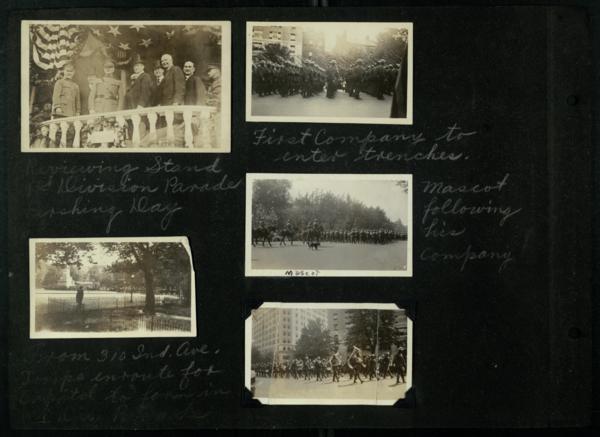
Of particular interest are the photographs of the Pershing Day Parade showing General John J. Pershing (1860-1948) in the reviewing stand, as well as military bands, gun carriages, men marching, and Red Cross nurses. The Washington, DC parade was held on 17 September 1919 and was the last great victory parade to celebrate the end of World War I. The parade also honored Pershing the American army general who was the commander of the American Expeditionary forces during the war.
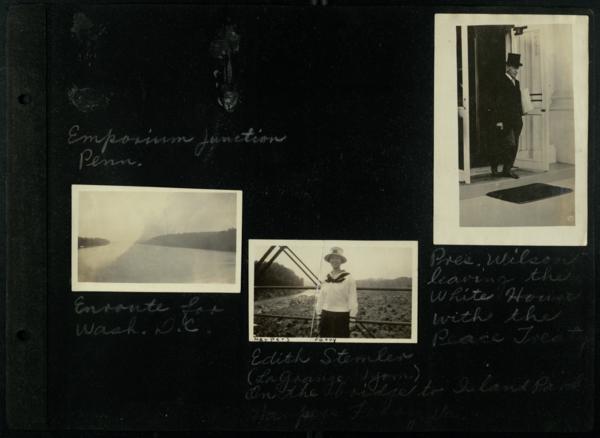
There is also a photograph of President Woodrow Wilson (1856-1924) holding the World War I peace treaty as he is leaving the White House. Wilson served as president of the United States from 1913 to 1921. After World War I ended in November 1918, he attended the Paris Peace Conference, advocated for the formation of the League of Nations, and signed the Treaty of Versailles in June 1919. Unfortunately, the Republican Congress refused to ratify the treaty, which was a great disappointment to Wilson.