Manuscripts
Katherine Johnson Papers
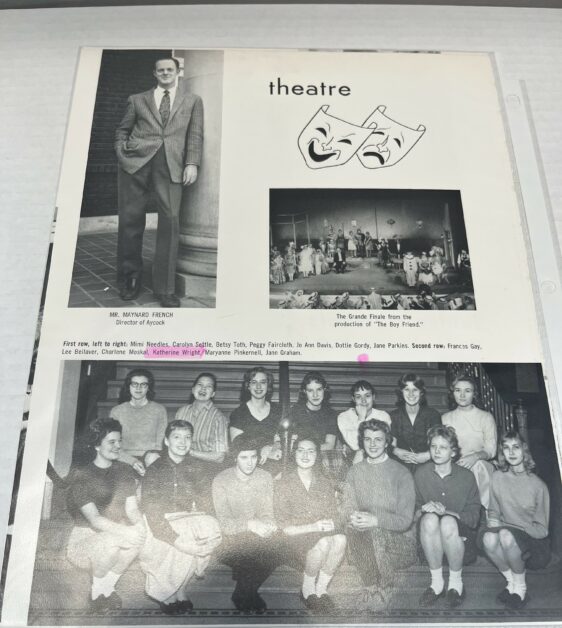
Katherine (Wright) Johnson was born on August 30, 1938. She attended the Woman’s College (now UNC Greensboro) from 1956 to 1960, earning a bachelor’s degree in Theatre Arts. During her junior year, she participated in a USO tour to military bases in the Far East, with stops in Japan and South Korea. She later taught elementary school in Maryland and worked for ten years as a teacher’s aide and library aide within the Hanover County Public School system.
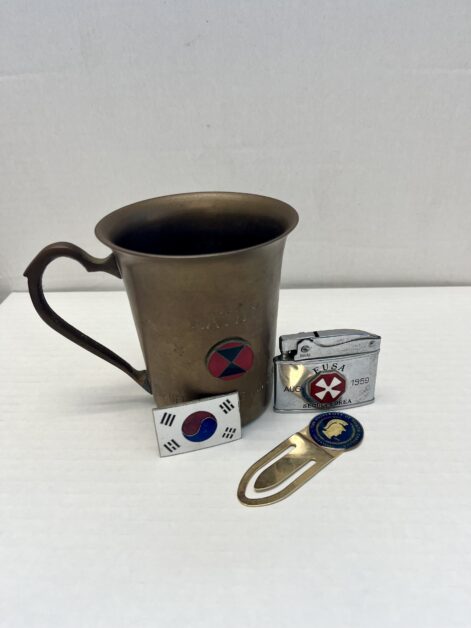
The collection consists of materials dating from 1957 to 2005, including artifacts, letters, photographs, and other documents. Her scrapbook holds newspaper clippings, correspondence to her mother, report cards, postcards, photographs, and additional items that illustrate her experiences as a theatre student at Woman’s College and her life after graduation. The collection also includes artifacts obtained during her overseas USO tour, featuring items from South Korea and Japan.
Rare Books
Artists’ Books by Edward H. Hutchins
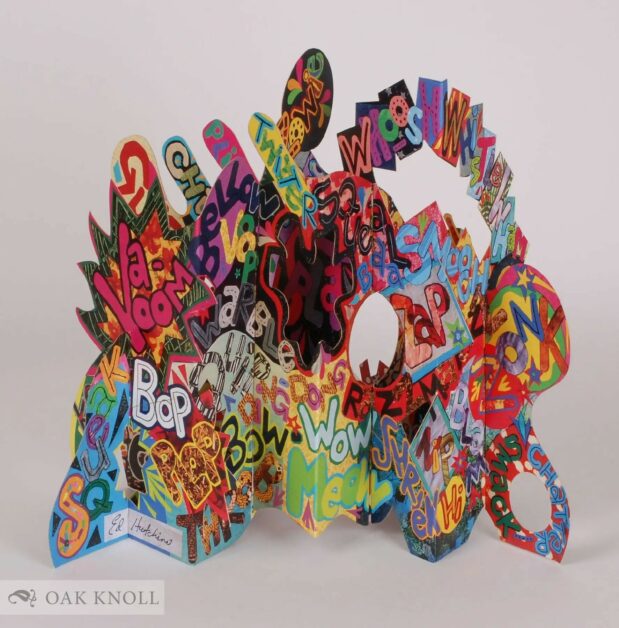
Cacophony
This piece is made up of a series of interconnected panels that fold flat and extend to reveal a vibrant display of silent sound expressions.
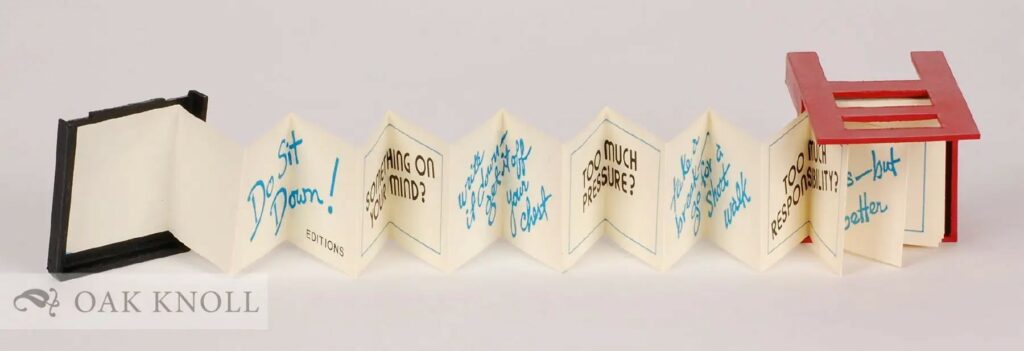
Do Sit Down!
Wisdom emerges from the seat of a small, painted chair. The pages extend to four feet in length, yet they are all contained on a single legal-sized sheet of paper, which has been photocopied in two colors.
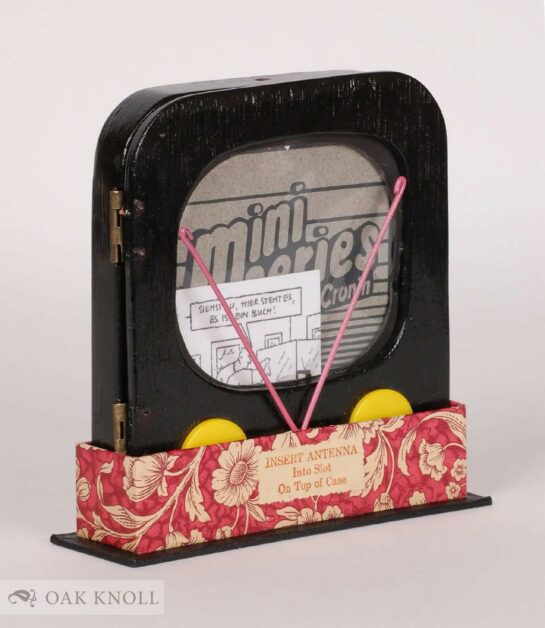
Miniseries / Ted Cronin and Edward Hutchins
Contains numerous linocuts by Hutchins throughout, illustrating a dream experienced by the author and comparing the dream to a television “mini-series.” The book is securely housed within a folding wooden box designed to resemble a television set, featuring an “antenna” crafted from a metal wire coat hanger. One of 30 numbered copies signed by Ted Cronin and Edward Hutchins.
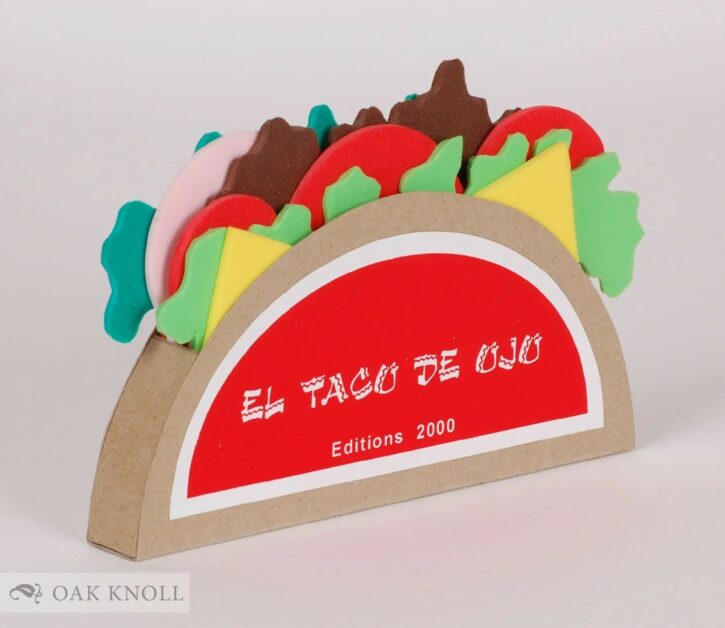
El Taco de Ojo (Easy on the Eye)
Seven pages filled with various ingredients are enclosed within a taco-shaped shell. The ingredient pages feature silk-screened phrases related to food, hunger, and desire. Each page contains silk-screened text panels on both sides, with Spanish text accompanied by English translations on the reverse side. The box is numbered, and the artwork is signed and numbered by the artist on the paper taco shell.
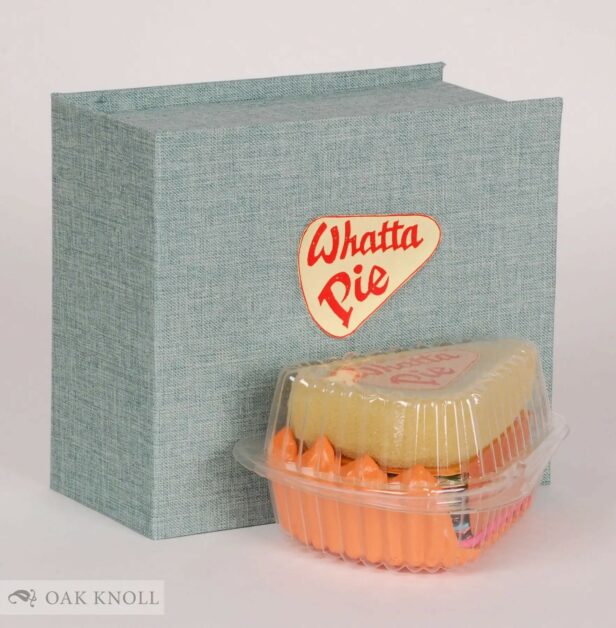
Whatta Pie
Inspired by Hutchins’ experience at a prior Meals on Wheels event, this publication features a collection of twelve legends, anecdotes, and quotes related to pies, presented in the shape of a pie. The interior cover includes an explanation of the phrase “upper crust.” Subsequent pages explore topics such as Mom and Apple Pie, Chicken Pot Pie, Pie in the Sky, Pizza Pie, Four and Twenty Blackbirds, as well as mathematical Pi and printer’s Pi.
Three Facsimiles
The Bird’s Head Haggadah of the Bezalel National Art Museum in Jerusalem
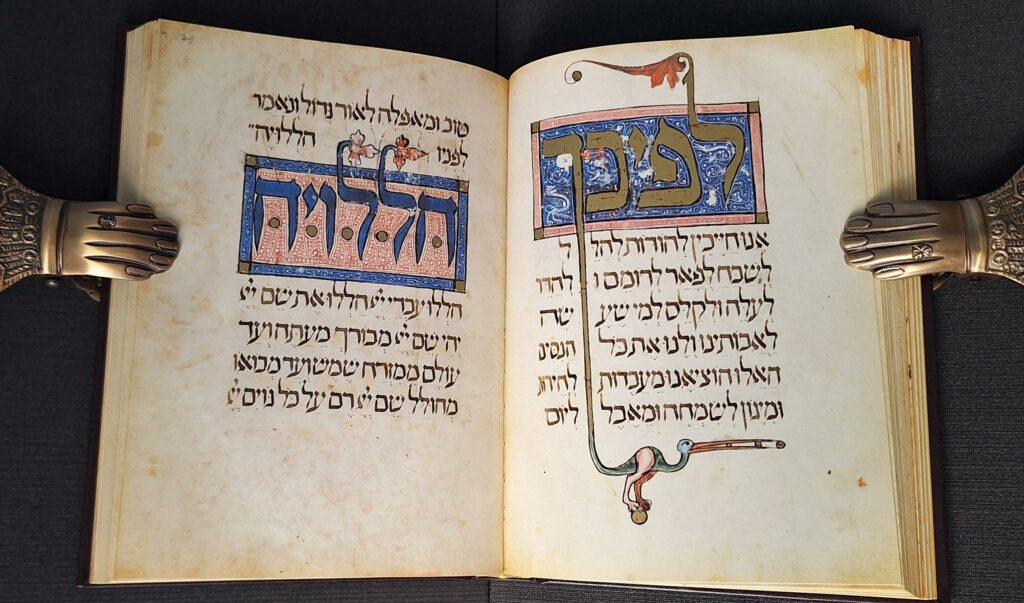
The Bird’s Head Haggadah is the earliest surviving illustrated German Haggadah manuscript, serving as a compilation of blessings, biblical passages, commentaries, psalms, and instructions for conducting the Passover Seder, the ceremonial meal observed on the first or both first and second evenings of the Jewish holiday. This manuscript provides valuable insight into the cultural practices of Jewish communities in southern Germany around the late 14th century. Many of its illustrations depict activities related to the Passover celebration and Seder rituals, including details of contemporary attire and customs. The name “Bird’s Head Haggadah” derives from its distinctive figural artwork, which features human figures with large bird-like heads, often with pointed ears rather than human facial features.
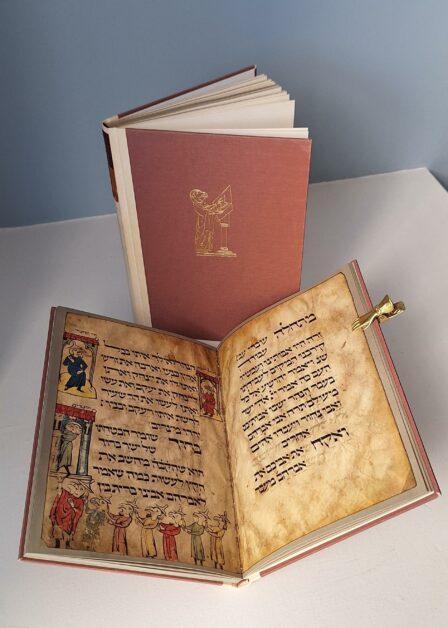
The Golden Haggadah / Narkiss, Bezalel, British Library
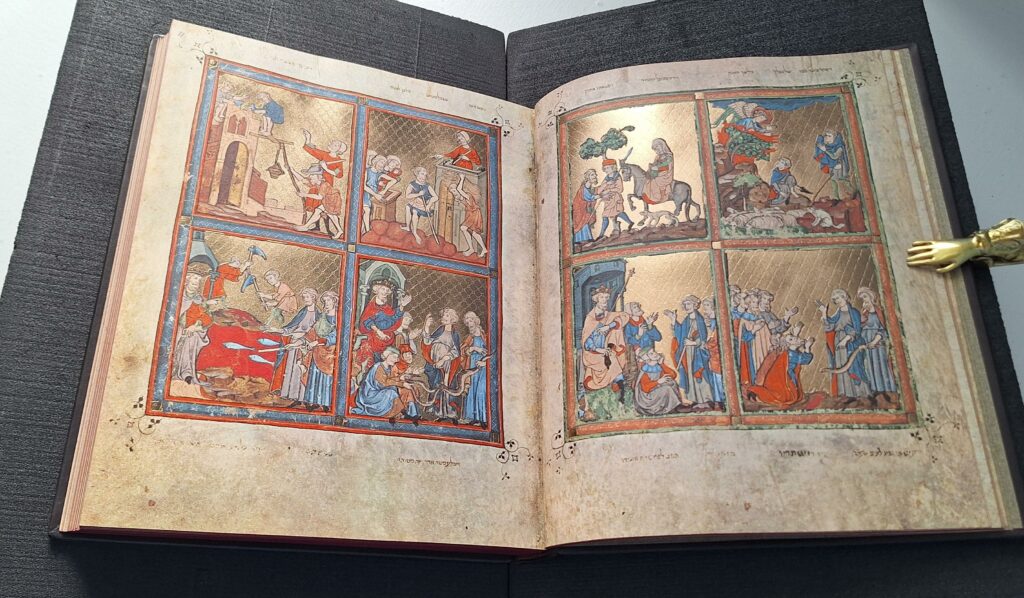
The Golden Haggadah, a significant artifact from fourteenth-century Spain, is among the most elaborately decorated medieval manuscripts created for the Jewish Passover Seder. Its most notable feature is the frontispiece, which consists of paired full-page miniatures. Each miniature is divided into four sections and is alternated with pages that contain text added in the seventeenth century. The main body of the Haggadah is inscribed in Hebrew Square Script, with the poetic and liturgical texts presented in one, two, or three columns. While the original illumination of the Golden Haggadah was primarily executed in the Gothic style in fourteenth-century Catalonia, additional text and illumination were incorporated in northern Italy in 1602 when the manuscript was given as a gift from Joab Gallico to his daughter Rosa.
The Sarajevo Haggadah
The Sarajevo Haggadah is a valuable artifact representing the visual culture of Sephardic Judaism. Likely produced in the Crown of Aragon around 1335, the manuscript begins with a distinguished series of thirty-four prefatory miniatures crafted in the popular Gothic style. The biblical illustrations are notable for adapting Christian compositional elements to suit the Jewish context, frequently including details that reflect Jewish commentary. The manuscript was created by two scribes using Hebrew square script, with one responsible for the main text of the Haggadah and the other for the poetry section.
Special Collections
Additions to SC0009 Project Based Learning Exemplars Collection
ARH 359 Art and/as Social Justice Fall 2025
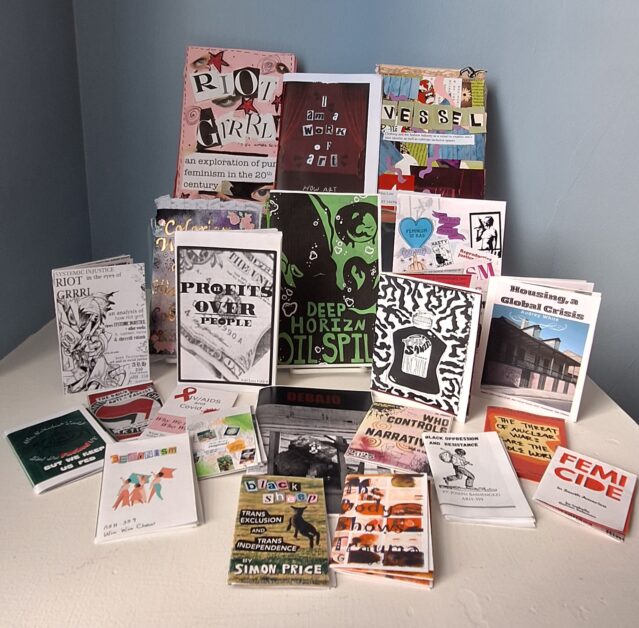
Students enrolled in Dr. Elizabeth Perrill’s course participated in a zine workshop and presentation hosted by SCUA. Their work has now been preserved as part of SC 0009.
ART 328 Printmaking II Spring 2026
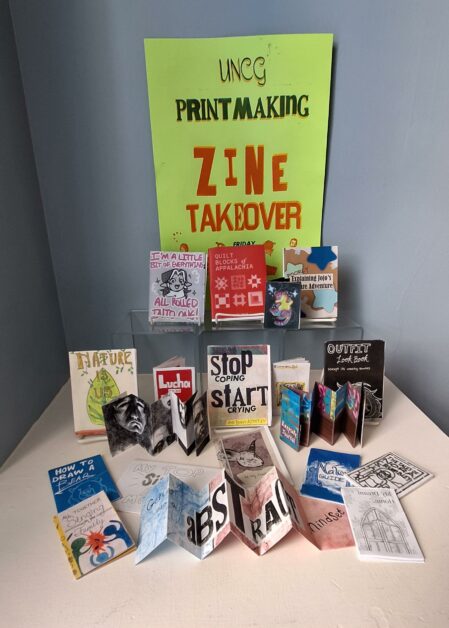
Students enrolled in Topher Alexander’s course participated in a zine workshop and presentation hosted by SCUA. They held a Zine Takeover event at a local secondhand bookstore. Their work has now been preserved as part of SC 0009.
University Archives
Woodstock Typewriter
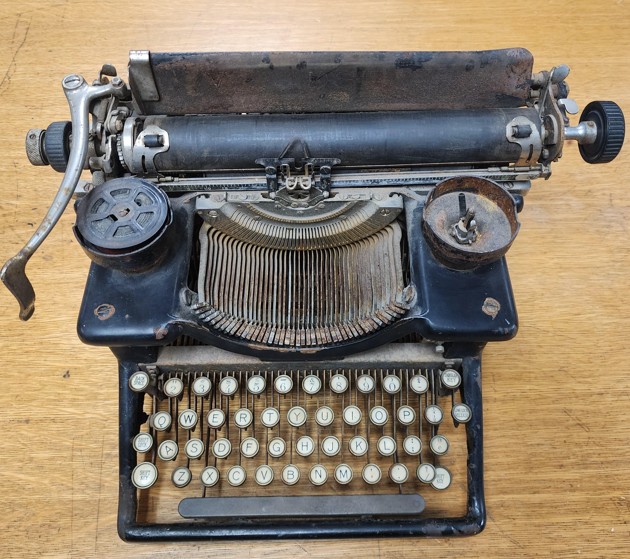
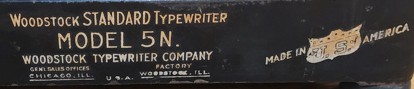
This Woodstock typewriter (ca. 1923), acquired from the University’s Coraddi Office, recalls a time when letters and manuscripts were produced by hand at the keyboard. It was manufactured in Woodstock, Illinois, a city once celebrated as the “Typewriter Capital of the World.” This Model 5N is black cast iron with gold lettering. Because of the model’s popularity and prevalence, it is not surprising that one found its way into the Coraddi Office at the North Carolina College for Women (now UNCG).
The Coraddi itself holds a distinguished place in campus history. First published on March 15, 1897, as State Normal Magazine, it was renamed in 1919 to include part of the names of the Cornelian, Adelphian, and Dikean literary societies. Today, the publication continues online, appearing each April and November and showcasing creative work from across the University community.
Women Veterans Historical Project
Anchors Aweigh! A Bulletin for Wave Enlistees from the 13th Naval District
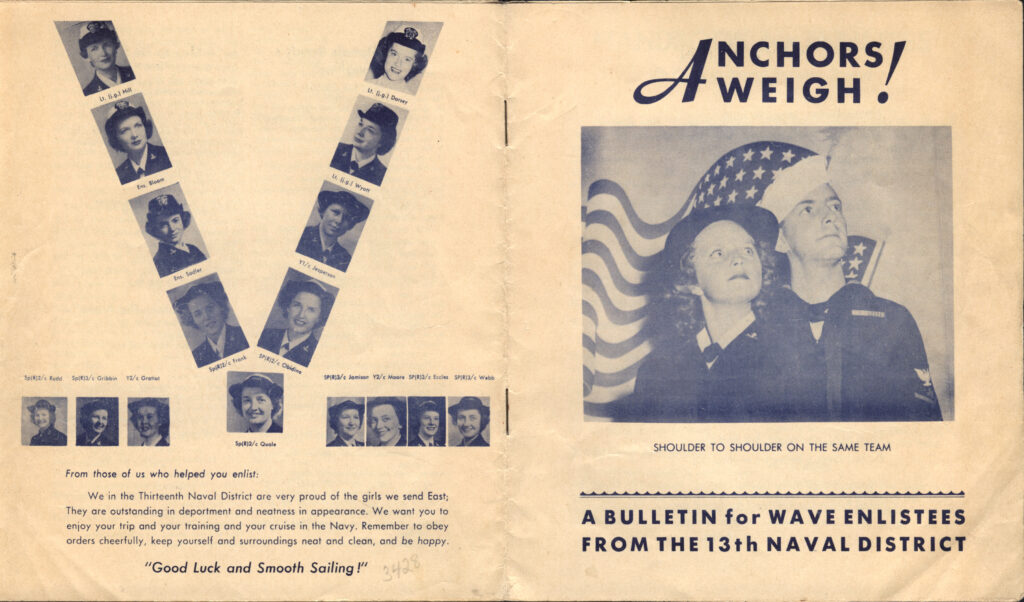
This publication, circa 1943, includes information for the U.S. Navy WAVEs enlistees from Washington, Oregon, Idaho, Montana, and Wyoming who travelled to the Naval Training School at Hunter College in New York City. The booklet includes information about expected behavior, with a list of fifteen “things to remember” including physical appearance, the officer-in-charge, functioning as a group, meals, inspection, no drinking, short patrol, group leaders, “sound off”, just in case (getting lost), luggage, valuables, arrival in Chicago and New York. There is also a description of what to expect at boot camp including billeting, selection tests, jobs and assignments, a glossary of Navy terms, and songs.
Elizabeth Benson Scrapbook
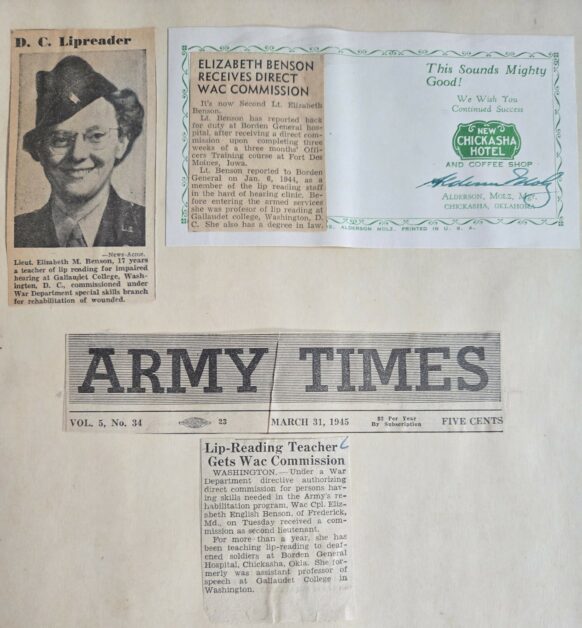
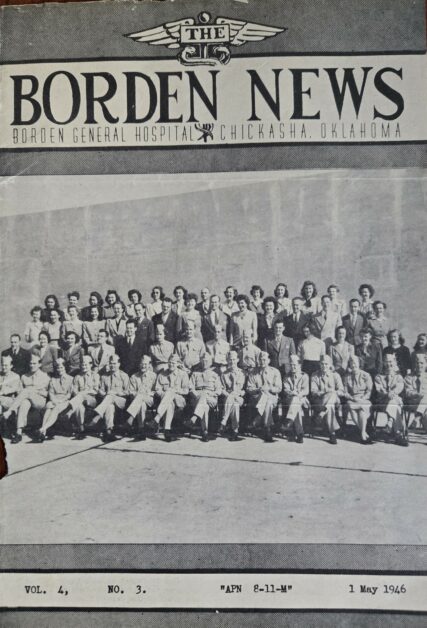
Elizabeth English Benson (1904-1972), of Frederick, Maryland, served in the United States Women’s Army Corps (WAC) from 1943 to the late 1940s. Benson was born to deaf parents and learned American Sign Language as a child. In 1923, Benson joined the faculty at Gallaudet College in Washington D.C. and instructed graduate students in lip-reading and audiology. She was then promoted to professor. In the early 1940s, she volunteered as a driver with the American Women’s Voluntary Services (AWVS), the largest American women’s service organization in the United States during World War II. In 1943, Benson enlisted in the WAC and did her basic training at Fort Oglethorpe, Georgia. She was assigned to the Army Service Forces Eighth Service Command at the Borden General Hospital in Chickasha, Oklahoma to help deafened soldiers learn to lip read. She received a direct commission and completed Officer Candidate School to earn the rank of Second Lieutenant. After her military service, Benson returned to Gallaudet and in 1950 was appointed the Dean of Women. In 1970 she retired and in 2014, a newly constructed barracks at Fort Sam Houston, Texas was named in her honor.
The collection includes a photograph album, the pamphlets So He is Hard of Hearing and For Your Orientation in the Hearing Program; a copy of My G.I. Hearing Aid, a 1946 collection of comics about Borden General Hospital Hearing Clinic by David O. Watson; a copy of an orientation booklet to Borden General Hospital printed by Southwestern Bell Telephone Company; newspaper and magazine clippings, official correspondence, and ephemera.
Sadie Snider Correspondence
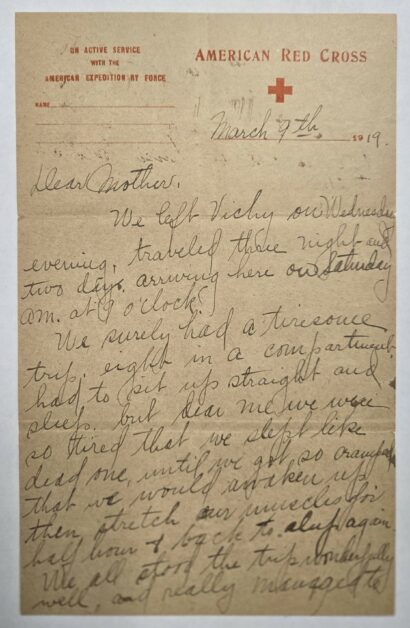
Sadie Snider served in the U.S. Army Nurse Corps during World War I. This collection of nineteen letters were written by Snider, who was serving with Base Hospital Number One in France, to her mother in Baltimore, Maryland. The letters range from March 1918 to March 1919, and in them Snider wrote about the sea voyage to Europe, nurses and soldiers she met, conditions in the hospital, and the flu epidemic.
Ruth Dickinson Papers
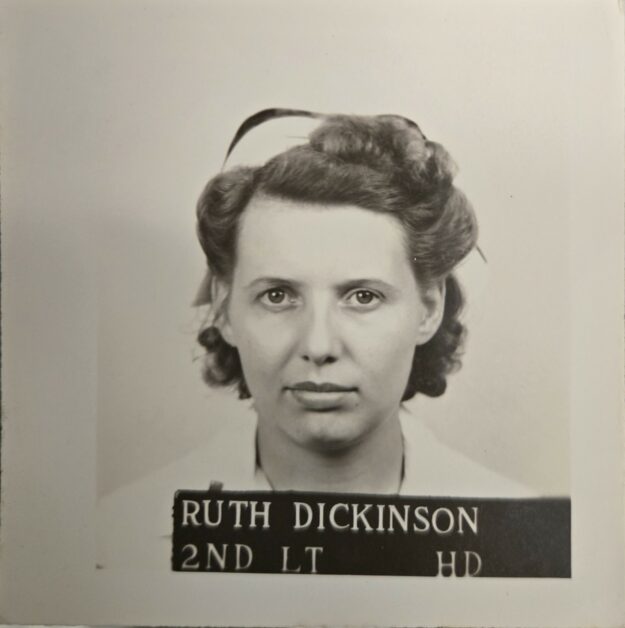
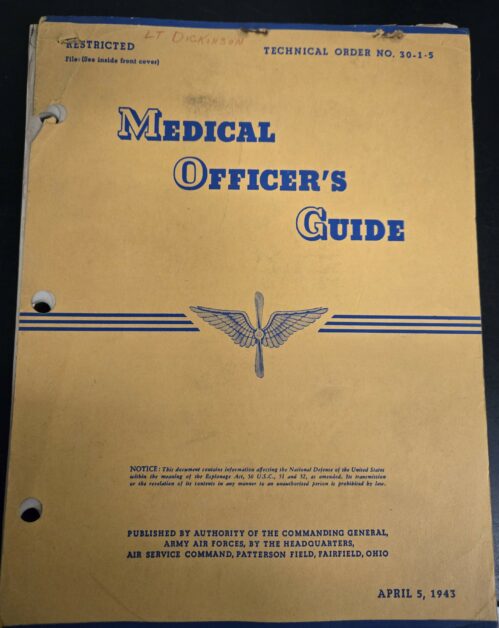
Ruth Dickinson (1918-1992), of Providence, Rhode Island, served as a dietitian in the United States Army Medical Specialist Corps from 1943-1946. Her assignments included the station hospital at Randolph Field in Texas and Selma Field in Monroe, Louisiana. The collection includes correspondence, guides/manuals from her assignments, photographs, postcards, military papers from her appointment to discharge, and newspaper clippings.
Mary T. Hunt Scrapbook
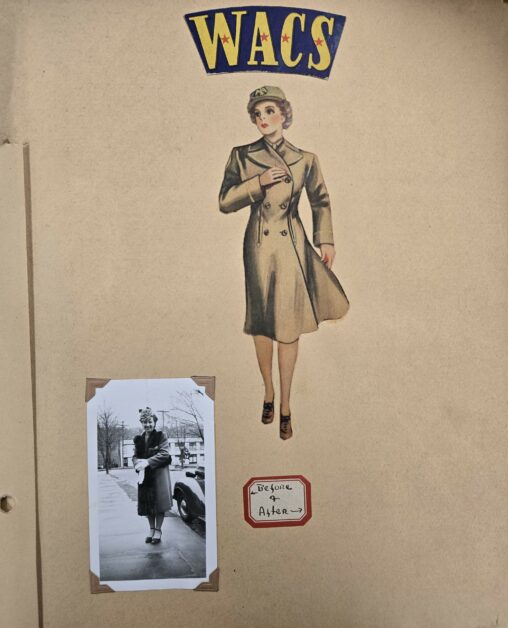
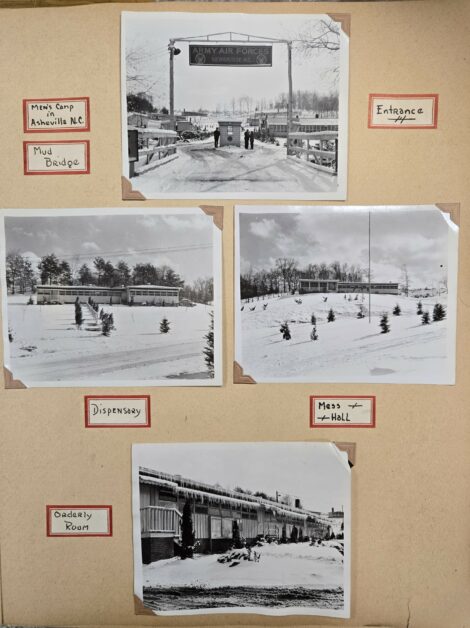
Mary Teresa Hunt (1906-1996) enlisted in the U.S. Women’s Army Corps (WAC) in 1944. She did her basic training at Fort Oglethorpe, Georgia. She was stationed at the Orlando Army Air Force Base in Florida and then with the Army Air Force’s Airways Communication System (AACS) in Asheville, North Carolina. The AACS provided air-to-ground communications, navigation aids, and air traffic control for military aviation during World War II. After the war Sergeant Hunt worked at Langley Field in Virginia.
Mardell Decker Scrapbook
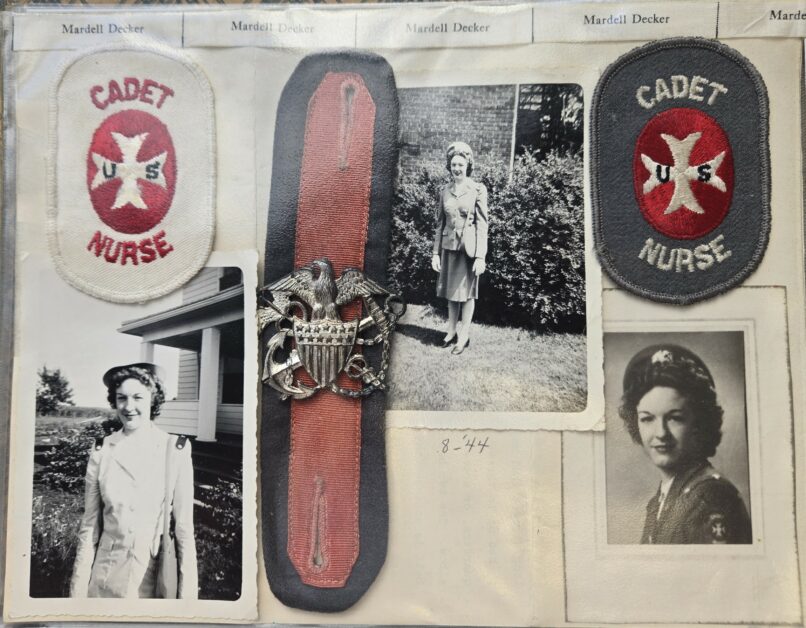
Mardell A. Decker (1923-2018) served in the U.S. Cadet Nurse Corps during World War II. She completed her nurse’s training at Roseland Community Hospital in Chicago, Illinois and served in the Corps from 1943-1946.
Ada “Gladys” Grove Scrapbook and Photograph Album
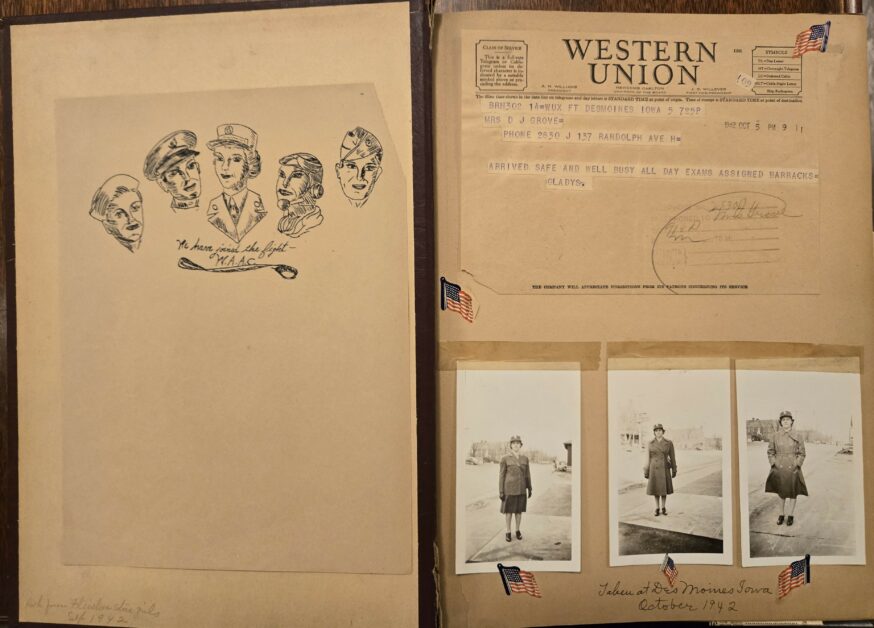
Gladys Grove (1905-1988) served in the U.S. Women’s Army Auxiliary Corps (WAAC) and the Women’s Army Corps (WAC) from 1942 to the 1950s. She did her basic training at Fort Des Moines, Iowa in late 1942 and graduated as a mess sergeant at Fort Oglethorpe, Georgia in June, 1943. In 1951, she was stationed at the Pepperrell Air Force Base at Newfoundland, Canada.
Gertrude Schnaitter Papers
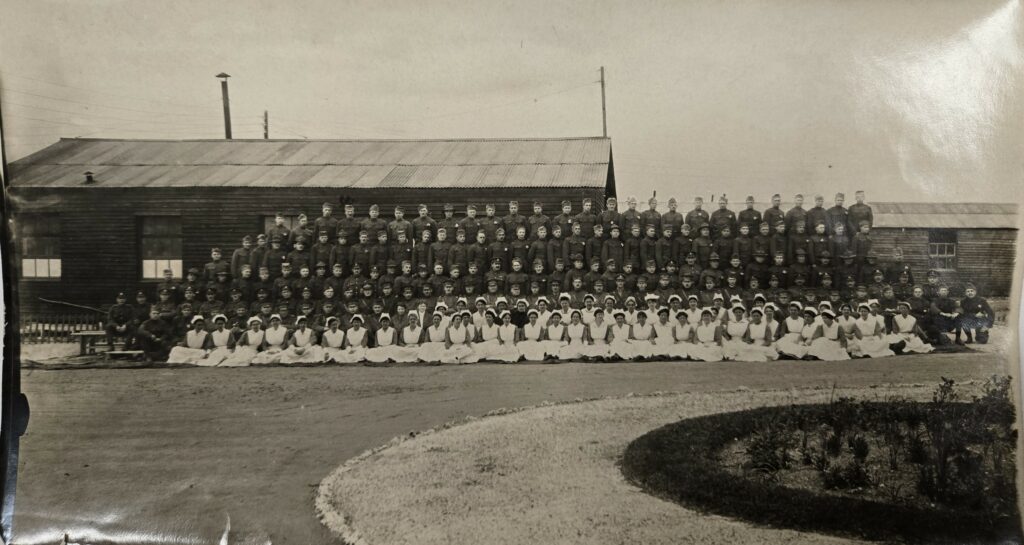
Schnaitter served as a nurse with the American Red Cross during World War I. She joined the American Red Cross Lakeside Hospital Unit in Cleveland, Ohio in 1916. The unit was attached to Base Hospital Number 4 in Rouen, France. The photograph album includes snapshots of her pre-deployment training in Philadelphia, Pennsylvania. There are also clippings, a telegram, official papers, and ephemera in the collection.