by Halenia Phillips
Arguably, the most vital connecting point between people is food. It connects to the soul, to the very history of a person. A meal shared is a history shared, and what better medium to connect so many young women of different backgrounds and stories than food? A college campus needs its dining areas- its little restaurants and hidden spots to provide a meeting ground and a common place for students. Food serves as this tool for connection in two very distinct ways: the academic and the social. At the Women’s College, these two methods found their way to intersect often under the careful work and tutelage of the home economics students and their professors. This is especially true of the 1930s, wherein the rest of the outside world was facing a crisis of economic and agricultural concern- the great depression. Yet somehow in this little alcove of the world, we see not sadness or grief, but rather we see small examples of hope, joy, and responsibility undertaken by the women of the time. One such example is a map doctored by a senior Home Economics student, Emma Lee Aderholt, and her cohort of fellow students. Within it is the anecdotal evidence that unlocks the larger mystery of how food acts as both a unifier and a motivator. These students are creating a social environment, which is academia.
First, to understand the map and thus to understand the path of food, which provides this important first step to understanding food pathways, we must understand the context in which it was made. Most important is to understand the background of the map’s creator, Emma Lee Aderholt. Aderholt was, from various accounts, a well-established and artistic member of the home economics department, the map not being her only accomplishment of 1934. The Carolinian, newspaper for the women’s college, documents her winning third place in the textile exposition1. The infamous map was designed by Aderholt alongside a group of students in the home economics department2 in 1934. However, there is no specific mention of the students who aided her in such. Further, we see her listed among the students in the department on page 38 of Pine Needles, 1934 edition, as a senior3. Through research into school newspapers from the time wea we discover that the map was created as a fundraising effort- the winning map to be sold to bolster the home economics department4. Others have seen the unique nature of the map, eventually reaching enough notoriety to be featured in the women’s map collection at the Library of Congress from the Ethel M. Fair collection5, which was curated to showcase maps that accurately capture the feminine perception of space and geography. What makes this map so much more special is that it provides a unique perspective on the school from the eyes of the home economics department, arguably the most involved programme in student life and culture. There is another version of the map that does exist, doctored by one Betty Allerdice and her editor for the 1935 yearbook. This map is a blank slate devoid of character- it erases all identifiable features about spots on the campus, such as yum yums6 or the dining hall7. There are no sweet little blurbs about the students partaking in Mayday, nor the comments regarding tea time with the faculty8. This one, so stripped clean, takes away the social content, which erases the value of the home economics students and their hard work. The work that Aderholt would have participated in as part of her field of study
During the Map’s inception, the Women’s College was going through a time of strife similar to that of the entire country- the great depression. From 1929 to 1939, the country plummeted into an economic panic. During the more specific period of Aderholt’s time9 and the eventual publication of the map10,111933 to 1935, President Franklin D. Roosevelt implemented a hundred-day reform plan and the Great New Deal. A common practice among women’s colleges across North Carolina became the canning of goods en masse as a part of the live at home initiative12. Current North Carolina Governor Max O. Gardner’s program was originally intended for (continue from live at home article)13. Now this is interesting, considering that it would have been a task most likely undertaken by volunteers as well as implemented as a part of the home economics department’s nutrition and institutional management programs. (cite specific entrances from course catalogs) The 1934 course catalog specifically mentions that the study of foods and cookery will include ‘the study of food preparation and the source, as well as how to manufacture them’14. So it is curious again that something of such great importance had failed to be mentioned in the map. Perhaps because it was a solemn affair? Such as meals are often perceived frequently in times of mass hunger. But I pose that it is a simpler reason- to the student’s food was a grander emotional importance that took precedence over the responsibility of things like canning and ensuring nutritional health.
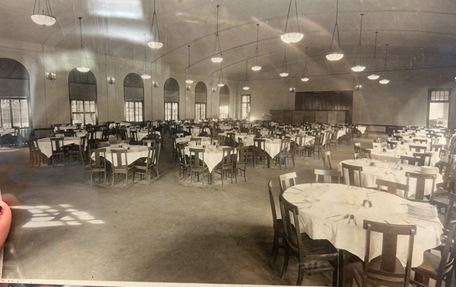
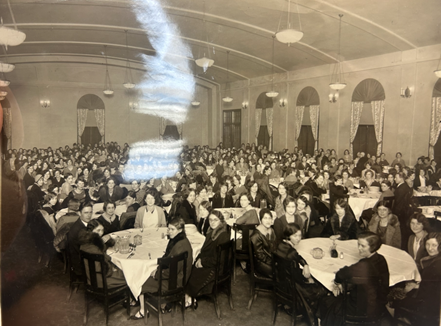
The map itself proves this claim that, despite food’s somber context in the grander scheme of things, it ultimately served as a social platform and a place of care among students in a time of hardship. We see this first as the dining hall- the place in which the canning took place- has a sweet yet simple blurb stating ‘Food’s paradise and Angel’s hash!”15 Well, what does this have to do with anything, one might find themselves asking? For a student in the home economics department, such as Aderholt, a place like the dining hall, where so much responsibility has been thrust into the hands of these young women, 16– both to serve the community and to intake as a part of their studies, means everything. It means that despite the strife, it is a paradise. The connotation of the word implies a decadence, an almost opulence about the space itself. Which, upon examination of photographs of the dining hall from the 1930’s, is a little laughable to think of in a modern context- but considering the era of the depression, the sheer volume of tables, the classy setting, and the closeness of people together as depicted in figure 6, one can understand this word choice. Per the college bulletin vol. 24-25, the building itself was three large halls connected through a central serving room with the kitchens and a cold storage plant17. There is mention of the dining hall having the capacity for eight hundred people, but the wording is a little difficult to follow- regardless of whether it was eight hundred in total of the three adjoining halls, that would still be an exorbitant amount of people gathered in one place. Further paired with the “angel’s hash”18 portion of the blurb brings some insight to the food itself, as angel’s hash was a frugal dessert made with simple ingredients (something rather representative of the great depression). As well as sobering us to the time period once again- a tangible connection to the sadness of the wider world at the time turned reverent via food and a meaningful place of connection.
Another plausible conclusion is that the responsibility of social reform had been on the backs of home economics students for quite some time now, so this use of female labor via lesson planning and academic program was not unusual and provided no reason for special mention on the map. Home economics, from its inception, was designed to weave together the social fabrics. According to Apple, the founders of home economics as an academic practice felt that society as a whole was on a decline, that it is ‘nothing less than an effort to save our social fabric from what seems to be disintegration19’. Responsibility to ensure social unity, then, is intended to come from course curricula, skills that can be transferred outside the home and into greater society. The 1934 course catalog denotes some such curricula as things such as nutrition, industrial methods of cookery20, both intended to have that broader societal impact. Many interpret home economics as a study of solely the household, but this could not be more false. Rather, at its height, Home Economics focuses on community service, which would strengthen the necessity for every student to be confident, efficient, and effective in her domestic tasks so she would have time to pursue her social responsibilities and turn them outward21. In the height of the depression, the fact that the students were still upholding this throughout the college is nothing short of commendable. Further, a testament to their dedication to the craft and a hopeful resolve for the future of society.
Fostering connection does not end with just the instruction of cookery, nor the kitchens. The dining hall itself, managed by students, something we see in the society section of the Carolinian, posted November 23rd, 1934, the same year as the maps creation, and directly within the year that Aderholt would have been undergoing the same lessons as her cohorts. In two articles, there are examples of the academic requirement to foster social situations and connections via food. The first in the society section of the paper, where home ec. Students host a luncheon for Vera Birttain in the private home economics cafeteria22, a location not mentioned in the map but one listed within the course catalog. Interestingly enough, the catalog posits that the home economics building had a total of seven different labs, which held a private cafeteria, a tea room/hosting hall, and a large industrial kitchen23. When examining the map, it is hard to imagine that what seems like a small building could hold so much, but the blurb regarding ‘tea time at 4:3024’ helps to connect this snippet to the understanding of what is important to the home economics students. There is also reason to believe that sugar, spice, and everything nice is possibly a reference to the kitchens wherein these things would have been accessible. Furthermore, in the same Carolinian article, it states that students were responsible for hosting faculty as well. Within the same newspaper, we see a host of out-of-campus professors and their cohorts being hosted in the private lunchroom for the day, such as Dr. Florence25. This is no doubt an example of the institutional management special direction of home economics, which is the detailed study of dining room and kitchen equipment26.
In all, food is the predominant tool that links the social and the academic together. It is the placeholder, the medium, and the catalyst to force social interaction. One cannot do so successfully without the proper training and skill; in each situation, fostered, there is a memory documented upon the map. A physical manifestation of academia linked via geography.
Fig. 1 Dining hall snapshot; 1934 Women’s College birdseye map, Aderholt, Emma Lee.
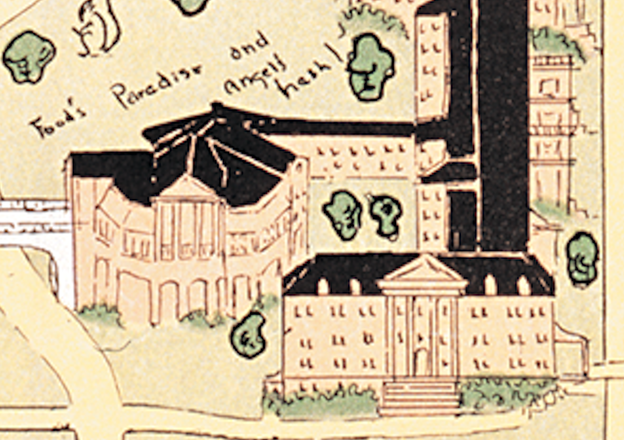
Fig 2. Text snapshot above Mciver building; 1934 Women’s College birdseye map, Aderholt, Emma Lee.
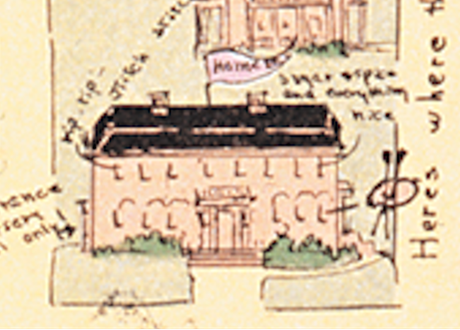
Fig. 3 Yum Yums snapshot; 1934 Women’s College birdseye map, Aderholt, Emma Lee
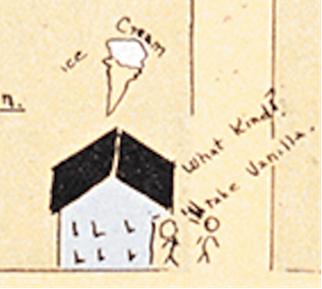
Figure 4 and 5: Snapshots from the women’s college dining room circa 1930s.
Annotated Bibliography
Primary Sources:
Aderholt, Emma Lee. “A Bird’s Eye View of the Campus of the Woman’s College of the University of North Carolina.” Digital History Collections > University of North Carolina at Greensboro > University Archives Collections > Blueprints, Drawings, and Maps All Records. 5575 Garden Village Way A102, Greensboro, NC 27410: J.O.S. J. Stone & Co., Printers, Greensboro, NC, 1934. https://www.digitalgreensboro.org/record/64912?ln=en&p=campus+map&v=uv#?xywh=401%2C5165%2C1079%2C595.
Aderholt’s map, the foundation for the entire assignment, is essential to understanding the students’ understanding of the Women’s College and what life was like on campus during the era of the Great Depression. It creates both geographic and social context for the campus in 1934, providing insight into smaller stories and experiences not as prevalent in other official college records. What was included has purpose, just as much as what is left out. My focus is on food, its accessibility, and the two major pathways it takes on campus. The distinct lack of importance on food is intriguing and acted as a springboard for my research on why it was left out despite being an integral part of a person’s day-to-day life.
Allardice, Betty. Pine Needles [1935]. Edited by Bet Nelson. Greensboro, NC: Senior Class of the Women’s College of North Carolina; Greensboro, NC, 1935. https://lib.digitalnc.org/record/28035?v=uv#?xywh=-92%2C156%2C5285%2C3065&cv=8.
The yearbook provides a stark contrast to the nature of the home economics map authored by Aderholt. The plain nature and depiction of the campus acts as a foundation for knowing and understanding the context and importance of Aderholt’s map.
Carolina. “Bulletin of the Woman’s College of the University of North Carolina [1935-1936].” North Carolina Yearbooks, 2026. https://lib.digitalnc.org/record/34664?ln=en&v=uv#?xywh=1723%2C2016%2C3821%2C2217&cv=132.
Digital Greensboro. “Alumnae News [February 1935].” Woman’s College of the University of North Carolina, 2026. https://www.digitalgreensboro.org/record/68493?ln=en&p=emma+aderholt&v=if.
Digital Greensboro. “Alumnae News [February 1936].” Woman’s College of the University of North Carolina, 2026. https://www.digitalgreensboro.org/record/68494?ln=en&p=emma+aderholt&v=if.
Digital Greensboro. “Pine Needles [1934].” Woman’s College of the University of North Carolina, April 28, 2026. https://www.digitalgreensboro.org/record/71383?ln=en&p=1934+pine+needles&v=if.
Digital Greensboro. “Pine Needles [1935].” Woman’s College of the University of North Carolina, April 28, 2026. https://www.digitalgreensboro.org/record/71384?ln=en&p=1935+pine+needles&v=if.
Digital Greensboro. “The Carolinian [January 18, 1935].” The University of North Carolina at Greensboro, January 18, 1935. https://www.digitalgreensboro.org/record/75596?ln=en&p=%22emma+lee+aderholdt%22&v=pdf.
Digital Greensboro. “The Carolinian [May 4, 1934].” The University of North Carolina at Greensboro, May 4, 1934. https://www.digitalgreensboro.org/record/75176?ln=en&p=emma+aderholt&v=pdf.
Digital Greensboro. “The Carolinian [November 23, 1934].” The University of North Carolina at Greensboro, November 23, 1934. https://www.digitalgreensboro.org/record/75519?ln=en&p=cafeteria&v=pdf.
Health Sciences Library. “LibGuides: Food and Nutrition through the 20th Century: The Great Depression.” Unc.edu, 2019. https://guides.lib.unc.edu/nutrition-history/great-depression.
Miss Hope Coolidge, College Dietition from 1921-1939. n.d. Manilla Folder.
A great resource for dining room expectations and what procedures the girls would have undergone. As the Dietician, Miss Coolidge would be in charge of making it run smoothly. From the document, it seems as if dining was a formal affair as opposed to the modern casual buffet style. Meant to reflect the structure they were trying to instill in the girls of the college. This provides context for why the dining hall seemingly has so much less personal story added to it on the map.
THE WOMAN’S COLLEGE OF THE UNIVERSITY of NORTH CAROLINA. The Woman’s College of the University of North Carolina: The Forty-Fourth Session [the Catalogue 1935-1936]. Digital Greensboro. Vol. 24–25. THE COLLEGE AT GREENSBORO, NORTH CAROLINA: Woman’s College of the University of North Carolina, 1936. https://www.digitalgreensboro.org/record/71310?ln=en&p=%28+%28creator%3A%5BUniversity+of+North+Carolina%5D%29%29&v=if.
This is a catalog that gives direct insight into the academic ways nutrition was taught and how food was used. It is key to understanding the context behind how food was regarded on the women’s college campus during the time of the great depression. Furthermore, it can establish some context as to how Aderholt, the home economics student, would have come into contact with food for her studies. Helping to understand maybe some of the reasons she excludes, such as her little blurbs added to personalize her map.
UNCG. Dining Halls- Interior 1922-1959. 1930. Black and white photograph. Manilla Folder.
This source is a collection of photographs documenting the dining halls from the 1930’s on UNCG Campus. They depict the arrangement and setup in the early great depression. Each photograph has been selected and chosen because of its range being close to the year the Map was created. It provides a visual context for dining culture on college campuses. I plan to use them when talking about spatial context for the map’s features that relate to food and food pathways.
Udel.edu. “H. E. Dining Room, Women’s College of Del., 1918–1930, from the Delaware Postcard Collection – Greetings from Delaware,” 2026. https://exhibitions.lib.udel.edu/greetings-from-delaware/exhibition-item/h-e-dining-room-womens-college-of-del-1918-1930-from-the-delaware-postcard-collection/.
This photograph from the H. E. Dining Room at the Women’s College of Delaware depicts a dining setup similar to that of the UNCG dining hall photos. This establishes a baseline for what dining culture was across multiple campuses in the United States.
Woman’s College of the University of North Carolina. The Woman’s College of the University of North Carolina: The Forty-Second Session [the Catalogue 1933-1934]. Digital Greensboro. Vol. 22–23. 1934. THE COLLEGE AT GREENSBORO, NORTH CAROLINA: North Carolina College for Women. Accessed March 31, 2026. https://www.digitalgreensboro.org/record/71308?v=if.
This is a catalog that gives direct insight into the academic ways nutrition was taught and how food was used. It is key to understanding the context behind how food was regarded on the women’s college campus during the time of the great depression. Furthermore, it can establish some context as to how Aderholt, the home economics student, would have come into contact with food for her studies. Helping to understand maybe some of the reasons she excludes, such as her little blurbs added to personalize her map. This is from the year the map was created.
Secondary Sources:
Apple, R.D. and Coleman, J. (2003), “As Members of the Social Whole”: A History of Social Reform as a Focus of Home Economics, 1895–1940. Family and Consumer Sciences Research Journal, 32: 104-126. https://doi-org.proxy180.nclive.org/10.1177/1077727X03032002002
This paper examines the development of domestic science as an academic field for American women at the turn of the century. It provides context for understanding how domestic science, or home economics, developed. A great way to learn how it has developed so much to include food and nutrition. Primarily focusing on the origins of home economics and how it gave way to social sciences, rather that it was the first academic social science.
Gorgosz, Jon. “‘No Formal Cooperation Needed’: Federal New Deal Policy at Elite Massachusetts’ Women’s Colleges, 1933–1942.” Historical Journal of Massachusetts 49, no. 2: 100–127. Accessed April 15, 2026. https://www.westfield.ma.edu/historical-journal/wp-content/uploads/2021/09/No-Formal-Cooperation-FINAL-COMPRESSED.pdf.
I like this article because it helps to contextualize the Federal New Deal policy that was put in place to aid schools during the Great depression.
Lowe, Margaret. “The Mind/Body Problem: College Women’s Attitudes toward Their Bodies, 1875-1930.” Umass.edu, 2026. https://scholarworks.umass.edu/entities/publication/78a70d38-9e75-47bb-bcce-806ab8088464.
This source is good for identifying and providing the general psychology of the time surrounding food for women. Specifically, college-age women who were under societal standards for maintaining a healthy and attractive body. It also develops an understanding of the relationship college women had with food before the great depression, providing insight into how it may have developed during the great depression.
UNCG University Libraries. “UNCG’s Buildings and Grounds | UNCG University Libraries,” August 12, 2024. https://library.uncg.edu/about-us/library-departments/special-collections-university-archives/university-archives/uncgs-buildings-and-grounds/.
Useful for understanding the buildings and developments on canvas by year.
wisdomlib.org. “Recipe for Angel Hash.” wisdomlib.org. Accessed May 1, 2026. https://www.wisdomlib.org/recipes/angel-hash-187783.
The recipe for Angel Hash provides some insight into the kinds of food they would be preparing and eating.
One thought on “Food’s Paradise and Cookery Labs: Mapping Food Pathways ”